It wasn't a straight line: it was a broken loop
 AI
André Izarra
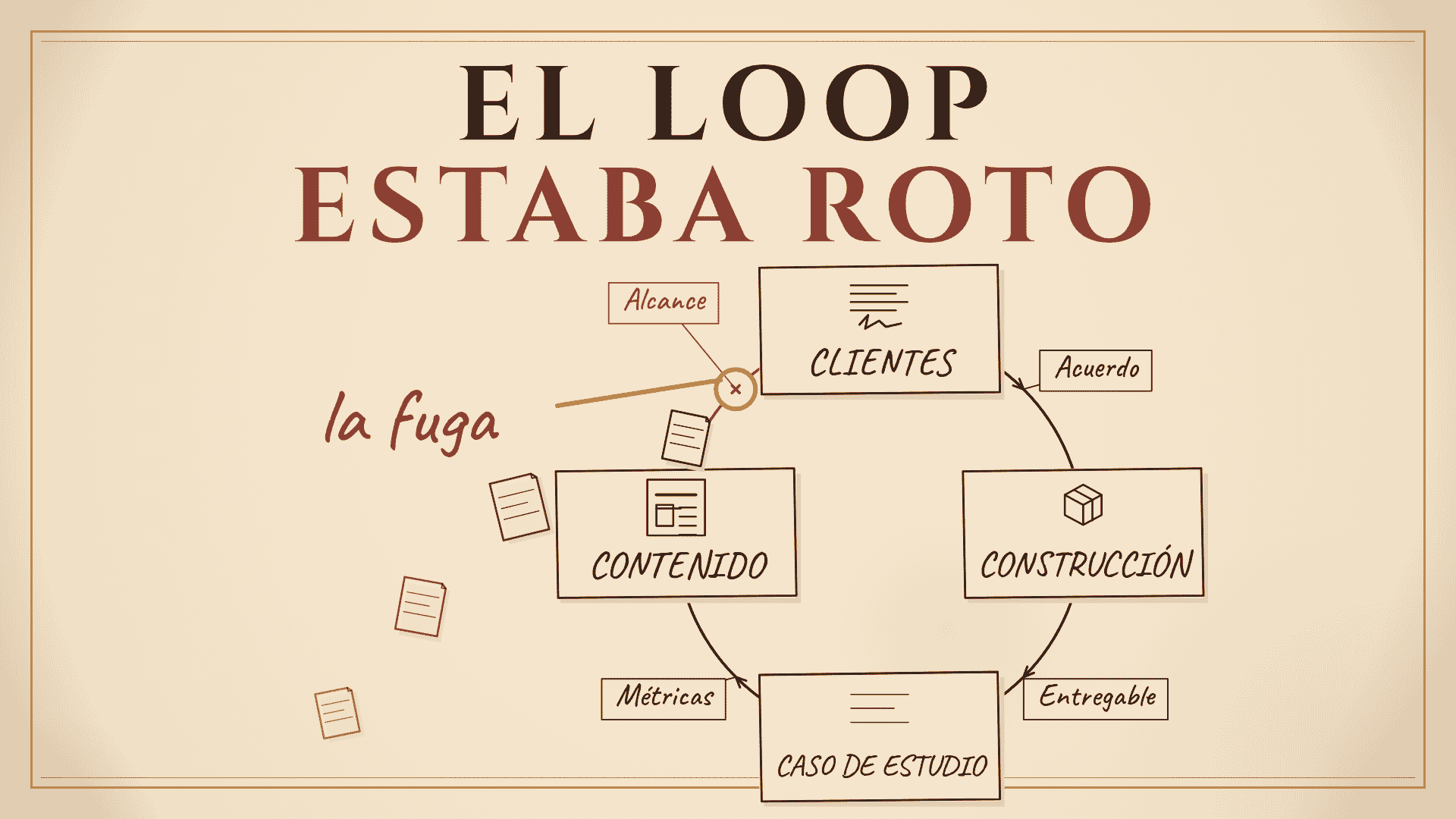
It wasn’t a straight line: it was a broken loop
For four years as a freelancer I had no system. I had a straight line that broke on the inside.
If your process lives only in your head, stay: what follows is what it took me four years to see. This post is the written version of this week’s video (in Spanish), for readers who prefer it written down. The leaks went out one by one on LinkedIn, with their numbers; each one is linked where it belongs.
What I called a process
I looked for clients, turned what they needed into technical requirements, built the solution, shared the experience on LinkedIn, updated my portfolio and repeated. It looked simple, and it was.
The problem was everything that escaped along the way. I never used the result of one step to feed the next. That is all a system is, and I didn’t have one.
The four leaks
The first one was the diagnostic
I started auditing businesses without charging for it. Once I spent two weeks understanding a client’s business: their problems and pain points, what they actually needed and not just what they asked for. I handed over a complete plan, with the requirements, the decisions and the implementation process. Then they told me they wouldn’t continue. Two weeks completely wasted.
Planning is a deliverable, and it has value on its own. I was giving it away for free without noticing. I told it with its numbers in Two weeks of diagnostic. Zero charged.
The second one was the build
I started from scratch with every client when I could reuse things I had already built. I built a near-identical module three times from scratch, with different tools. I learned a lot, and I don’t regret it (I rewrote the same module three times). What I do regret is failing to separate two things: improving my craft and improving my system. You can do both. But every time you start from zero, you reset your own progress.
The third one was the metrics
I did real work for clients and often couldn’t prove the numbers. The case study told the story without the proof: the client knew the improvement, I knew it, but I couldn’t point to a single metric. Without measuring before you start there is no before and after, and the proof is what sells the next client (You can’t improve what you don’t measure).
The fourth one was the content, and it was the quietest
I did good work for years and nobody knew I existed (Nobody knew I existed). My new clients came from the old ones: people close to clients who liked my work. I never reached anyone else. New clients don’t only come from past clients: they come from people seeing your work.
The fifth thing: nothing was written down
Above all the leaks sat the most important one, and it was the reason I couldn’t see them. Nothing was written down.
A client’s lesson stayed in my head instead of becoming part of my process. A badly estimated deadline stayed a bad memory instead of a recorded fact. Everything lived in my mind, so I depended on remembering the mistakes I had made before. And memory is not a system: a system records its own results (I priced every client from memory).
Trying to do it better next time is not a system either. It is hope.
The loop
This year I wrote the whole process down. The stages were there from the start: close an agreement, build, turn it into a case study, share it, and repeat. A loop, not a straight line.
Each stage feeds the next. The better the result of one stage, the easier the next one gets and the better its result: the improvement is exponential. A good diagnostic leaves scoped projects that finish on time, with the right budget and without friction. Reusing what you already built, when it makes sense, raises your productivity. Measuring before the work leaves a before and an after, and the case study becomes content without effort. The problems you solve today are the content that gives you reach, and reach brings the next client.
Your turn
Your process is a loop too. Look at it, split it into stages and write it down. Fill each stage with real records and look at which ones are especially hard: a poor result may come from an earlier stage, or from a whole stage that never existed. When every stage produces its result, the system improves on its own. And if you make a mistake it stays recorded: you adjust and keep moving.
So, what are you waiting for? Have you defined your process yet?
If you made it this far, thank you for reading. If any of this sounds like your own cycle, write to me: we all learn from each other’s mistakes.